

 Kashef Qaadri
Executive Summary
At AI Summit 2025, leaders from across the life sciences came together to explore how artificial intelligence (AI) is transforming the biomedical pipeline. The event featured a keynote address and four expert panels, with each focused on a critical stage of innovation, from experimental design to diagnostics and manufacturing.
The keynote address, which was delivered by Mustaqhusain Kazi of Roche, emphasized that AI is no longer optional. Indeed, organizations must move quickly to build capabilities or risk falling behind. A five-pillar framework incorporating strategic value, technology infrastructure, people and culture, data excellence, and responsible AI was proposed to guide successful AI transformation.
Each panel reinforced this message with practical insights:
- Panel 1 showed how AI is improving experimental design and early discovery through better metadata integration and simulation-driven antibody design
- Panel 2 highlighted AI’s role in scaling high-throughput screening and integrating multiomics data to accelerate compound discovery
- Panel 3 focused on translational intelligence, emphasizing the need for trust, transparency, and responsible AI in clinical diagnostics
- Panel 4 explored AI in bioproduction, showcasing how automation and real-time optimization can improve yield and consistency
The summit highlighted that success with AI depends not only on technology but also on strategic alignment, cultural readiness, and ethical governance.
Introduction
Leaders from across life science disciplines met at AI Summit 2025, hosted by Bio-Rad Laboratories, Inc., to explore how AI is transforming the journey from biomedical discovery to diagnostics and manufacturing. The event featured a keynote address and four expert panels, each focused on a distinct stage of the biomedical pipeline. The discussions showed how AI is accelerating innovation, improving precision, and enabling scale and also highlighted the cultural, technical, and ethical shifts required to realize its full potential.
Keynote Summary – Turning AI Ambition into Reality
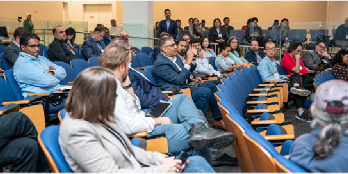
Engaging discussions at the event.
Delivered by Mustaqhusain Kazi, Global Head of Informatics Strategy at Roche and Chairperson of the Board for the Alliance for Artificial Intelligence in Healthcare (AAIH), the keynote presentation set the tone for the summit by emphasizing that AI is already reshaping healthcare. The central message was clear: organizations must move quickly to build capabilities or risk falling behind permanently.
Take-Home Messages from the Summit
- AI transformation requires more than technology; it demands a shift in mindset, culture, and strategy
- Common reasons for AI project failure include lack of business alignment, poor data quality, and treating AI as a tech initiative rather than a strategic imperative
- A five-pillar framework for successful AI adoption was proposed, including strategic value, technology infrastructure, people and culture, data excellence, and responsible AI
- Federated data ecosystems and treating data as a product are essential for scalable and ethical AI
- Foundation models in language, vision, and multimodal domains are poised to revolutionize clinical documentation, radiology, and diagnostics
- Organizations must prioritize use cases based on impact and feasibility and embrace change management to overcome inertia
Expert Panels
Panel 1 – Design Smarter: AI in Experimental Design and Early Discovery
This panel explored how AI is streamlining early-stage research and experimental design.
The key findings were as follows:
- AI is improving sample matching and metadata integration, reducing time and cost while enhancing reproducibility
- Tools that combine structured and unstructured data are accelerating assay development and target selection
- RNA foundation models are being developed to optimize therapeutic properties and diagnostics
- Simulation-driven antibody design is advancing, yet validation and expert integration remain challenges
- High-quality metadata are essential for effective AI applications in early discovery
Panel 2 – AI-Powered High-Throughput Discovery: From Assay to Insight
Panel 2 focused on how AI is expanding the scope and scale of high-throughput screening.
The key findings were as follows:
- AI enables in silico experimentation and quantum chemistry simulations, increasing compound screening from hundreds of thousands to millions
- Multiomics integration is critical for building predictive models that reflect biological complexity
- Ethical data practices and patient privacy must be prioritized as data aggregation increases
- AI is helping researchers interrogate biology at scale, but infrastructure and incentives must evolve to support broader adoption
Panel 3 – Translational Intelligence: AI at the Interface of Discovery and Clinical Diagnostics
This session examined how AI bridges the gap between research and clinical application.
The key findings were as follows:
- AI is already impacting healthcare, but adoption requires cultural and strategic transformation
- A five-pillar framework for AI success was reinforced, emphasizing responsible AI and data governance
- Trust and transparency are vital, especially in regulated environments
- Organizations must focus on solving specific problems rather than building all-encompassing platforms
Panel 4 – From Bench to Bioreactor: AI in Bioproduction and Scale-Up
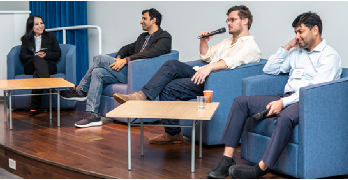
Experts sharing insights on AI-driven innovation.
The final panel addressed the role of AI in scaling biomanufacturing processes.
The key findings were as follows:
- AI-enabled factories with self-monitoring systems can optimize cellular conditions and improve yield
- AI tools can detect faulty markers and initiate corrective actions, enhancing consistency and quality
- Human oversight remains essential to validate AI outputs and ensure reliability
- Partnerships and incremental innovation are vital to overcoming barriers in adoption for manufacturing
Next Steps
To capitalize on the insights from AI Summit 2025, we should consider the following actions:
- Assess Strategic Alignment
- Identify high-impact, high-feasibility AI use cases across the organization
- Prioritize initiatives that solve real problems and deliver measurable outcomes
- Invest in Data Excellence
- Treat data as a product with clear ownership, governance, and quality standards
- Move toward federated data ecosystems to enable scalable and secure AI
- Build Cross-Functional AI Teams
- Assemble teams that combine domain expertise, data science, engineering, and compliance
- Foster a culture of experimentation and continuous learning
- Strengthen Responsible AI Practices
- Embed ethics, privacy, and fairness into AI development from the outset
- Ensure transparency and interpretability in models, especially in regulated environments
- Modernize Infrastructure
- Develop flexible, secure, and scalable platforms to support AI workloads
- Evaluate build-versus-buy decisions based on strategic importance and time-to-market considerations
- Engage with External Partners
- Explore collaborations with academic institutions, startups, and consortia to accelerate innovation
- Leverage shared learning and best practices from the broader AI ecosystem
Conclusion
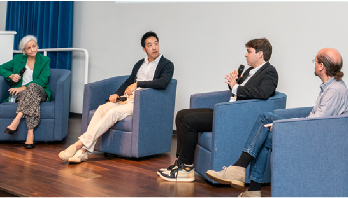
Collaborative dialogue shaping the future of biomedicine.
AI Summit 2025 showcased the transformative potential of AI across the life sciences value chain. From smarter experimental design to scalable bioproduction, AI is enabling faster, more precise, and more ethical innovation. The summit emphasized that success depends not only on technology but also on strategic alignment, cultural readiness, and responsible governance. Organizations that embrace these principles will be best positioned to lead in the next era of biomedical advancement.
Visit br.io for more information.
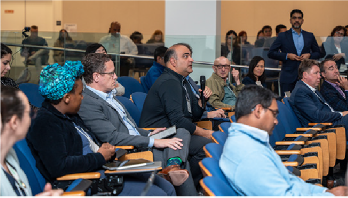
Audience participation during interactive sessions with keynote speaker.